
Malaysia’s New Incentive Framework (NIF) is a performance-based corporate tax incentive system that rewards companies according to measurable economic contributions rather than relying mainly on fixed tax holidays.
Announced under Budget 2026 and officially launched for the manufacturing sector on 1 March 2026, the New Incentive Framework (NIF) marks a major change in how Malaysia evaluates investment incentives.
Applications are assessed against specific criteria under the NIA Scorecard, including the quality of investment and its contribution to the Malaysian economy.
This means securing tax incentives now depends more heavily on how well an investment meets Malaysia’s strategic priorities.
Companies planning a new investment, expansion or incentive application therefore need to assess their eligibility earlier and prepare around the scorecard requirements before committing capital.
What Is the New Incentive Framework (NIF)?
The New Incentive Framework, or NIF, is Malaysia’s new way of assessing and granting tax incentives for investment projects. Instead of relying mainly on promoted activity lists, the framework looks at the actual value a business brings to the country.
Under NIF, companies are assessed based on measurable outcomes such as high value job creation, technology adoption, ESG practices, domestic supply chain contribution, and long term economic impact.
This means businesses need to show stronger proof that their investment supports Malaysia’s wider growth priorities before securing tax incentives.
Why Malaysia Replaced the Old System
Malaysia’s corporate tax incentive system had been built around the Promotion of Investments Act 1986 (PIA) for nearly 40 years.
Under that model, businesses listed under “promoted activities” could receive standard tax holidays or investment allowances even when their wider contribution to the Malaysian economy was limited.
The system mainly rewarded business presence instead of measurable performance.
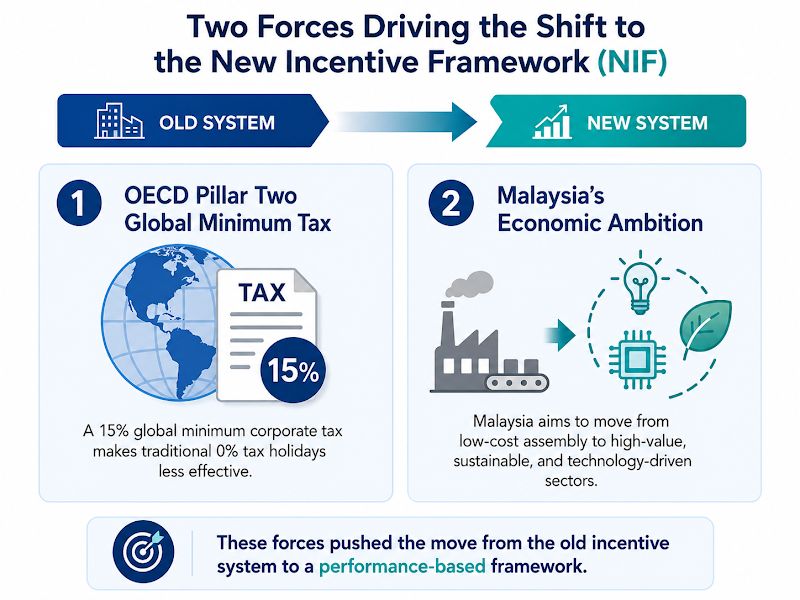
Two forces accelerated the change:
1. OECD Pillar Two Global Minimum Tax
International rules now set a 15% global minimum corporate tax. This means traditional tax holidays with 0% rates may be clawed back by a company’s home country, making them less effective as an incentive tool.
2. Malaysia’s economic ambition
The government wants to shift beyond a low cost assembly base and build stronger high value, sustainable, and technology driven sectors. The old checklist approach was no longer strong enough to support that transformation.
The NIF addresses both issues by linking incentives to measurable outcomes, economic contribution, and project quality.
Need clarity on how the New Incentive Framework affects your company? Speak to NKH for tailored guidance on your NIF eligibility and application.
The NIA Scorecard: How Your Business Is Evaluated
At the heart of the NIF is the NIA (National Investment Aspirations) Scorecard. The Malaysian Investment Development Authority (MIDA) uses this scorecard to evaluate every new application across six strategic pillars:
| NIA Pillar | What MIDA Looks For | Why It Matters |
|---|---|---|
| Economic Complexity | Advanced manufacturing, R&D activities, high-tech processes | Signals Malaysia is moving up the value chain |
| High-Value Jobs | Local hiring at competitive, above-market salaries | Reduces brain drain and boosts household income |
| Domestic Linkages | Sourcing from Malaysian SMEs and local vendors | Strengthens local supply chains |
| Industrial Clusters | Supporting established hubs (E&E in Penang, Aerospace in Selangor) | Deepens sector ecosystems |
| Inclusivity | Balanced growth across states, not just Klang Valley | Addresses regional economic disparity |
| Sustainability (ESG) | Carbon reduction plans, energy efficiency, green practices | Aligns with global ESG investor expectations |
Your NIA score determines which tier you qualify for.
What Is the Difference Between Tier 1 and Tier 2?
Tier 1 requires a company to meet both the minimum and additional conditions specified in its incentive approval, while Tier 2 requires only the minimum conditions. As a result, Tier 1 provides the more favourable level of tax incentive.
MIDA gives examples where a Tier 1 Special Tax Rate is 5% compared with 10% for Tier 2, while an Investment Tax Allowance example provides 100% allowance for Tier 1 versus 60% for Tier 2.
These are illustrative examples, so the actual incentive awarded depends on the company’s approved package and conditions.
The gap between tiers is significant, so preparation and positioning matter.
STR vs. ITA: Choosing the Right Incentive Path
Under the NIF, businesses cannot combine incentives. You must choose one of two mutually exclusive paths, and the right choice depends on your financial model and capital structure:
| Special Tax Rate (STR) | Investment Tax Allowance (ITA) | |
|---|---|---|
| What It Offers | Reduced corporate tax rate (0%–15%) for up to 15 years | Up to 100% allowance on Qualifying Capital Expenditure (QCE) for up to 15 years |
| Best For | High-profit, asset-light firms; tech companies expecting immediate income | Capital-heavy projects with large upfront investments in machinery or facilities |
| Income Offset | Lower tax on taxable income | Offsets up to 100% of statutory income |
| Mutual Exclusivity | Cannot be combined with ITA | Cannot be combined with STR |
| Tier Dependency | Final rate depends on NIA Scorecard tier | Allowance percentage depends on NIA Scorecard tier |
Key insight: Highly profitable, asset-light operations typically benefit more from the STR because they generate taxable income quickly. Capital-intensive manufacturers building large facilities usually get more value from the ITA, which offsets the heavy upfront expenditure.
Book your NIF consultation with NKH to compare STR and ITA options and identify the route with the strongest after tax benefit.
Rollout Timeline: When Does NIF Apply to Your Sector?
The government is rolling out the NIF in phases. Here is where things stand:
| Sector | Status | Key Date | What to Do Now |
|---|---|---|---|
| Manufacturing | Active | March 1, 2026 | Existing PIA approvals remain valid. New applications must use NIF. |
| Services | Incoming | Q2 2026 (est.) | Monitor MIDA for subsector-specific guidelines. |
| Existing Approvals | Protected | Run to original term end | No action needed; existing Pioneer Status and ITA continue unaffected. |
Important for existing approvals: If your company is already enjoying an active Pioneer Status or ITA approved under the old PIA, those approvals remain fully protected and will run their course under their original terms. The NIF applies only to new applications submitted after March 1, 2026 in manufacturing.
4 NIF Changes Malaysian Business Owners Need to Act On Before Applying
The NIF changes how businesses need to plan, document, and justify their investment applications. Companies that prepare early will be in a stronger position to meet the NIA Scorecard requirements and protect their incentive outcome.
Here are the key shifts business owners should review before submitting an application:
1. Your Application Must Tell an Economic Story
Gone are the days when a simple investment amount and sector classification secured an incentive. Your MIDA application now needs to quantify your contribution across all six NIA pillars: local hiring salaries, ESG commitments, supply chain sourcing, and more.
2. ESG Is No Longer Optional
Sustainability credentials are a scored component of the NIA Scorecard. Businesses without a documented ESG strategy or carbon reduction plan will score lower and may fall to Tier 2 or miss the threshold entirely.
3. Domestic Supply Chain Decisions Have Tax Implications
Choosing to source materials from Malaysian SMEs is no longer just a corporate social responsibility gesture. It directly affects your NIA score and, consequently, your tax rate for the next 15 years.
4. Professional Tax Advisory Is Essential
The complexity of optimising an NIF application, selecting the right incentive type, building NIA Scorecard documentation, and projecting 15-year tax scenarios, requires specialist expertise. Getting this wrong at the application stage cannot easily be corrected later.
How NKH Can Assist With Your NIF Application

NKH Chartered Accountants, your trusted tax firm in Malaysia, assists businesses with the tax, accounting, and advisory work needed for a stronger NIF application.
Our taxation services include reviewing company financial records, assessing tax incentive eligibility, preparing financial projections, comparing STR and ITA options, and advising on the most suitable tax structure.
We also support businesses in organising the required documentation, identifying gaps before submission, and aligning the application with NIA Scorecard expectations. This helps business owners apply with clearer numbers, stronger records, and a more practical incentive strategy.
Plan Your NIF Application With NKH
Malaysia’s New Incentive Framework has changed how businesses qualify for tax incentives. Companies can no longer rely on sector classification alone. The strength of your application now depends on how clearly you can prove job creation, local supply chain impact, ESG readiness, financial viability, and long term economic contribution.
A strong NIF application needs more than good business intentions. It needs clear numbers, proper documentation, and the right tax incentive strategy before submission.
NKH Chartered Accountants can help your business review NIF eligibility, compare STR and ITA options, prepare supporting financial documents, and strengthen your application based on NIA Scorecard expectations.
Speak to NKH for practical guidance on your NIF application and incentive strategy.
Frequently Asked Questions About New Incentive Framework
The New Incentive Framework is Malaysia’s new tax incentive model that assesses investment projects based on measurable economic contribution, and NKH helps businesses understand how this affects their tax planning.
Businesses planning new manufacturing investments or future expansion in Malaysia should review their NIF eligibility early with NKH before preparing an application.
STR gives a reduced corporate tax rate, while ITA gives allowance on qualifying capital expenditure, and NKH can help businesses compare which option gives a stronger after tax outcome.
The NIA Scorecard is the evaluation tool used to assess investment quality, and NKH helps businesses prepare the financial, tax, and business documentation needed to support their score.
NKH assists businesses with NIF eligibility review, STR and ITA comparison, tax projections, financial documentation, and advisory support before submission.