
Access to public capital has long been a challenge for Malaysian SMEs and mid-tier companies. LEAP Market 2.0 is the most significant regulatory reform in the platform’s history, and it could open doors your business has never had before.
Jointly proposed by the Securities Commission Malaysia (SC) and Bursa Malaysia, the LEAP Market 2.0 proposal introduces sweeping changes to listing access, investor participation, and the pathway to the ACE Market.
If your business falls under the MSME or mid-tier company category, understanding this proposal is critical to your capital-raising strategy.
What Is LEAP Market 2.0?
| Feature | LEAP Market (Original) | LEAP Market 2.0 (Proposed) |
|---|---|---|
| Retail Investor Access | Sophisticated investors only | Retail investors allowed (with caps) |
| Listing Route | Approved Adviser required | ECF-RMO or VC/PE firms eligible |
| Transfer to ACE Market | Full delisting + exit offer required | Direct transfer after 2 years |
| Disclosure Format | Standard Information Memorandum | Simplified disclosure document |
| Adviser Compensation | Cash fees only | Up to 50% in shares allowed |
| Investment Cap (Retail) | N/A | RM250,000 total; RM100,000 per issuer |
Bursa Malaysia introduced the LEAP Market in 2017 to give small and medium sized companies a more accessible route into the public market. However, its sophisticated investor only structure limited wider market participation and reduced its effectiveness as a funding platform.
LEAP Market 2.0 aims to address these gaps by opening a clearer pathway for growth companies that need public funding but may not be ready for the ACE or Main Market. The proposal follows policy direction from Finance Minister II and was later set out through a public consultation paper.
The reform also supports SC’s Capital Market Masterplan 2026 to 2030 and the 5 Year Roadmap for MSMEs and MTCs, with a focus on improving funding access for Malaysia’s estimated 8,500 mid tier companies.
Speak to NKH Chartered Accountants to assess your company’s readiness, review key structuring and tax considerations, and understand the next steps before moving toward a listing pathway.
5 Core Pillars of the LEAP Market 2.0 Proposal
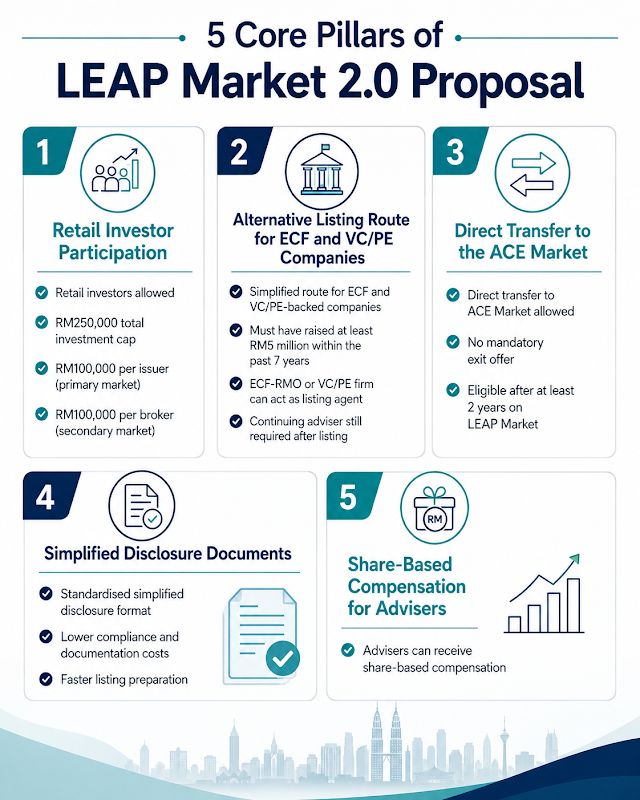
The LEAP Market 2.0 proposal focuses on making the market more accessible, liquid and practical for growth companies. The key changes can be understood through five core pillars.
1. Retail Investor Participation
For the first time in the platform’s history, retail investors will be permitted to participate in the LEAP Market, subject to strict investment caps designed to manage risk exposure:
- Maximum total investment of RM250,000 at any point in time
- Up to RM100,000 per issuer in the primary market
- Up to RM100,000 per broker in the secondary market
This change significantly expands the pool of available capital for LEAP-listed companies and introduces a secondary market liquidity layer that previously did not exist.
2. Alternative Listing Route for ECF and VC/PE Companies
Companies that have already raised capital through Equity Crowdfunding (ECF) platforms or Venture Capital and Private Equity (VC/PE) networks can now access the LEAP Market through a simplified admission route, bypassing the requirement for a traditional Approved Adviser.
Eligibility criteria for this alternative route:
- Successfully raised an aggregate of at least RM5 million via ECF or VC/PE within the past 7 years
- ECF Registered Market Operators (ECF-RMOs) or VC/PE firms act as listing agents
- A continuing adviser must still be appointed post-listing for compliance purposes
For early-stage businesses that have built their investor track record through private markets, this creates a more natural and cost-efficient progression to public listing.
3. Direct Transfer to the ACE Market
One of the most commercially significant changes in the LEAP Market 2.0 proposal is the removal of the mandatory exit offer requirement for companies transitioning to the ACE Market.
Under the original framework, moving from LEAP to ACE effectively required a full delisting, an exit offer to all existing shareholders, and a fresh listing application — a process that was prohibitively expensive and disruptive for most companies.
Under LEAP Market 2.0, companies can transfer directly to the ACE Market after a minimum of two years on the LEAP Market.
4. Simplified Disclosure Documents
Applicants under LEAP Market 2.0 will use a standardised, simplified disclosure format in place of the full-length Information Memorandum currently required. The revised format is designed to:
- Reduce compliance overhead and documentation costs
- Improve investor clarity while retaining material financial and operational data
- Accelerate the listing preparation timeline for smaller companies
5. Share-Based Compensation for Advisers
To ease the immediate cash burden on capital-constrained MSMEs, financial advisers involved in a LEAP 2.0 listing can accept up to 50% of their advisory fees in the form of the applicant’s ordinary shares. Boundaries to prevent conflicts of interest include:
- Maximum 2% shareholding per adviser
- Maximum 5% aggregate shareholding for all advisers combined
- Mandatory six-month lock-up period (moratorium) on share disposal post-listing
What LEAP Market 2.0 Means for Funding, Liquidity and Growth

The LEAP Market 2.0 represents a structural shift in how Malaysian businesses can access capital markets. For MSMEs and mid-tier companies, the practical implications are significant:
- Greater investor demand: Opening the market to retail investors means a broader pool of potential buyers for your shares, improving liquidity post-listing.
- Lower listing costs: Share-based adviser compensation and simplified disclosures reduce the upfront financial barrier.
- A clearer growth runway: The frictionless ACE Market transfer creates a defined path from startup to mainboard-level ambitions.
- Faster access if ECF or VC/PE-backed: If your company has raised private capital, the alternative listing route removes a major procedural barrier.
That said, listing preparation still demands rigorous groundwork. Corporate governance must be board-ready.
Financial statements must be clean and auditor-approved. Tax positions must be optimised before any due diligence process begins.
Speak to NKH Chartered Accountants to assess your listing readiness, strengthen your governance, organise your financial records, and prepare investor materials.
How NKH Chartered Accountants Supports Your LEAP Market 2.0 Strategy

NKH Chartered Accountants is a licensed member of the Malaysian Institute of Accountants for accounting firms in Malaysia, based in Klang, Selangor. We support Malaysian business owners with practical accounting, tax, corporate advisory, and listing readiness guidance so they can prepare with greater clarity and fewer compliance surprises.
For companies considering LEAP Market 2.0, we help strengthen five key areas.
Corporate Structuring and Governance
Our corporate advisory in Malaysia assesses your current company structure and identify gaps that may affect listing readiness. This includes reviewing shareholder arrangements, board structure, decision making controls, and internal governance policies so your business is better prepared for investor scrutiny.
Tax Planning and Compliance
We review your tax position before fundraising or listing discussions begin. Our tax planning services in Malaysia help identify tax risks, organise supporting records, review transfer pricing requirements where relevant, and prepare the tax information commonly needed during due diligence.
Financial Reporting and Accounting Systems
Clean, audited financials are non-negotiable for any public market listing. Our bookkeeping services upgrade accounting frameworks to investor-grade standards, implement e-invoicing compliance, and prepare financial statements ready for external audit submission.
Business Valuation and Investor Materials
We provide independent corporate valuations in Malaysia to help you understand your market position and develop investor-ready materials including pitch decks, executive summaries, and KPI reporting packages.
Regulatory and Application Support
Our team advises on LEAP Market 2.0 documentation requirements and coordinates with capital market intermediaries throughout the listing process, reducing the risk of delays or unexpected compliance gaps.
Start Preparing for LEAP Market 2.0 Before the Window Opens
LEAP Market 2.0 could create a more accessible listing pathway for Malaysian SMEs and mid-tier companies, especially those looking to raise public funding, improve investor access, and build a clearer route toward the ACE Market.
Although the proposal is still under public consultation, companies that prepare early will have a stronger advantage once the framework is finalised. Listing readiness is not something that can be rushed at the application stage. Governance, tax compliance, clean financial records, shareholder structure, and investor documentation all need to be reviewed and strengthened in advance.
NKH Chartered Accountants can help your business take the first step. Our team supports Malaysian companies with readiness assessments, corporate structuring, tax planning, financial reporting review, and investor documentation preparation, so you can approach LEAP Market 2.0 with greater confidence.
Speak to NKH Chartered Accountants today to assess your LEAP Market 2.0 readiness and build a practical preparation roadmap tailored to your business goals.
Frequently Asked Questions Leap Market 2.0
LEAP Market 2.0 is a proposed reform to help Malaysian growth companies access public funding through retail investor participation, simplified disclosures, alternative listing routes, and a clearer ACE Market transfer pathway.
Malaysian MSMEs, mid-tier companies, ECF-funded businesses, and VC/PE-backed companies should consider LEAP Market 2.0 if they are preparing for fundraising, investor entry, or future public listing.
Yes, NKH Chartered Accountants can review your company structure, financial records, tax position, governance, and investor documentation to identify readiness gaps before listing preparation begins.
Companies should prepare clean management accounts, audited financial statements, tax records, shareholder information, KPI reports, and supporting documents for due diligence review.
NKH supports LEAP Market 2.0 preparation through corporate structuring, tax planning, accounting review, business valuation, investor material preparation, and regulatory documentation support.
Early preparation helps businesses fix governance, tax, accounting, and reporting gaps before advisers, investors, or regulators begin reviewing the company.
Yes, NKH can help ECF and VC/PE-backed companies organise their fundraising records, financial reports, tax documents, and investor materials for the proposed alternative LEAP Market 2.0 route.
Yes, NKH provides business valuation support to help business owners understand their company’s financial position before fundraising, investor discussions, or listing preparation.