
The e-invoice Malaysia implementation date is nearing, and businesses must get ready for this change in the tax reporting system.
As part of the government’s effort to streamline invoicing and improve tax compliance, the e-invoicing system will be mandatory for Sdn Bhd and SME businesses.
This guide explains the exact implementation timeline, who needs to comply, how e-invoicing actually works, and what Malaysian businesses should be doing right now.
Find Your Deadline: E-Invoicing Malaysia Implementation Dates by Revenue Tier
E-invoicing in Malaysia will be implemented gradually, based on the annual turnover of businesses. Below is the updated timeline, reflecting the latest changes:
| Revenue Tier (Annual Turnover) | Implementation Date | Notes |
| Above RM100 million | 1 August 2024 | Mandatory for large businesses. |
| RM25 million – RM100 million | 1 January 2025 | Mandatory for medium-sized businesses. |
| RM5 million – RM25 million | 1 July 2025 | Applicable to businesses in this revenue range. |
| RM1 million – RM5 million | 1 January 2026 | Small businesses required to comply. |
| RM500,000 – RM1 million | 1 July 2026 | Final phase for small businesses. |
| Below RM500,000 | Exempt | Not required, but encouraged to adopt by 1 July 2026. |
Remarks : Below RM500k may be exempt based on revenue, but structure rules (group, shareholders, related transactions) can still trigger compliance.
For new businesses established between 2023 and 2025, the e-invoice implementation date is 1 July 2026, unless turnover exceeds RM1,000,000 sooner.
Ready to open SDN BHD? Discover how setting up your new company can align with e-invoicing requirements for smoother tax compliance and business operations.
Consolidation Rules Tightening from January 2026
From 1 January 2026, businesses can no longer freely consolidate multiple small transactions into a single e-invoice.
Key restrictions include:
- No consolidation where a single transaction exceeds RM10,000
- Certain industries must submit every transaction individually, with no consolidation permitted at all
Industries affected by the no-consolidation rule include construction materials, automotive, telecommunications (postpaid and devices), and high-value or luxury goods.
If your business operates in these sectors, or regularly handles large single transactions, your invoicing workflow needs to account for individual-level reporting from the start of 2026.
Speak to NKH Chartered Accountants to review your e-invoicing deadline, MyInvois readiness, and tax compliance requirements before the changes affect your business operations.
Who’s Exempt? Special Cases for E-Invoice Malaysia Implementation

Many business owners hear about the RM500,000 annual turnover exemption and assume they are safe. This assumption is risky.
Your company may still be required to comply earlier if any of the following apply:
- New Businesses (2023–2025): Businesses established during this period with turnover under RM1,000,000 are exempt until their revenue exceeds this threshold.
- Businesses Established from 2026: E-invoicing is mandatory from day one, but if turnover is below RM500,000, compliance starts from the second year.
- Consolidated E-Invoices: Allowed for transactions below RM10,000 until 31 December 2025. From 1 January 2026, individual invoices will be required for all transactions over RM10,000 and consolidated E-invoices will not be allowed.
Certain industries like automotive, aviation, and construction will need individual e-invoices regardless of the transaction value.
If you are unsure where your company stands, this is worth verifying now rather than after a deadline has passed.
Key Updates to SST and E-Invoice Requirements
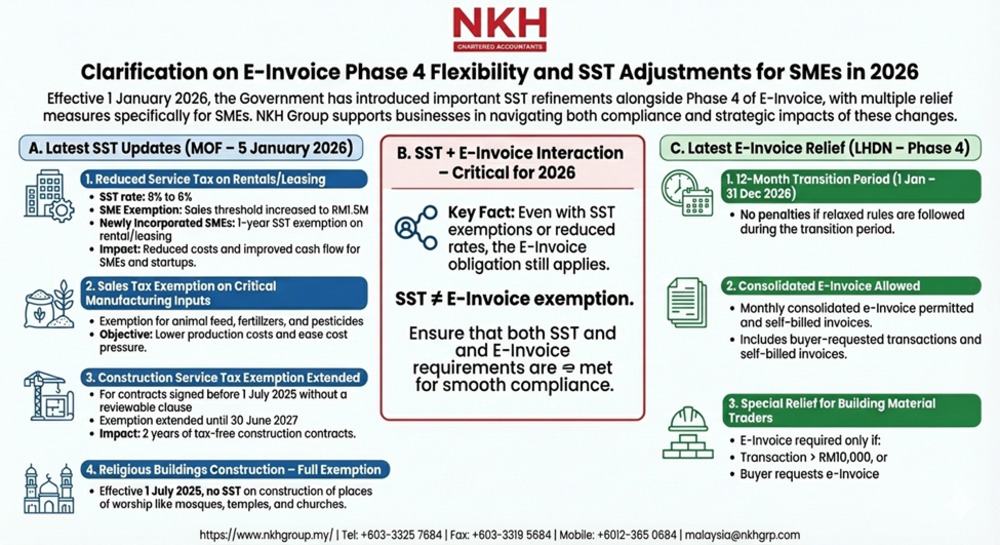
As businesses prepare for the mandatory adoption of e-invoicing, several important updates to the Sales and Service Tax (SST) have been introduced, along with critical clarifications on how these changes interact with e-invoicing obligations.
1. Reduced Service Tax for Rentals/Leasing
The SST rate for rental/leasing services has been reduced from 8% to 6%. The SME exemption threshold has been increased to RM1.5M, providing significant relief for SMEs, particularly for newly incorporated businesses that are eligible for a 1-year SST exemption on rental/leasing.
2. Sales Tax Exemption on Critical Manufacturing Inputs
Critical sectors like agriculture (animal feed, fertilizers, and pesticides) now benefit from an exemption, easing the cost pressures for businesses involved in manufacturing.
3. Construction Service Tax Exemption Extended
The tax exemption for construction services (for contracts signed before 1 July 2025) is extended until 30 June 2027.
4. Full Exemption for Religious Building Construction
Effective from 1 July 2025, there will be no SST on religious buildings like mosques and temples.
Note: The above Phase 4 relaxation across specific sectors is until 31 December 2026 with consolidation allowances.
While businesses can benefit from SST exemptions or reduced rates, e-invoicing obligations still apply. It’s crucial that businesses ensure compliance with both SST and e-invoice requirements.
Tax Incentive: Accelerated Capital Allowance for Compliance Costs
The government has introduced an Accelerated Capital Allowance to reduce the financial burden of compliance setup. Qualifying purchases include:
- Computers and hardware
- Accounting software
- E-invoice submission systems
- POS and ERP upgrades for MyInvois integration
Under this incentive, you can claim the full cost within two years instead of following the usual depreciation schedule. Planned early, your compliance investment becomes tax deductible before the incentive window closes.
Easing into E-Invoicing: Key Details on the Interim Relaxation Period
The government has introduced a 12-month transition period for businesses to adapt to the new e-invoicing rules. During this period, businesses will not face penalties if they follow the relaxed guidelines.
| Revenue Tier (Annual Turnover) | Interim Relaxation Period |
| Above RM100 million | 1 August 2024 – 31 January 2025 |
| RM25 million – RM100 million | 1 January 2025 – 30 June 2025 |
| RM5 million – RM25 million | 1 July 2025 – 31 December 2025 |
| RM1 million – RM5 million | 1 January 2026 – 30 June 2026 |
| Up to RM1 million | 1 July 2026 to 31 December 2026 |
During this period, businesses can continue to do consolidated invoicing online, and they will have extended timelines to comply with the new system.
Businesses that fail to meet the requirements within the relaxation period will not face prosecution, provided they follow the relaxed guidelines.
Reach out to NKH Chartered Accountants for guidance on e-invoicing compliance, bookkeeping alignment, and tax planning support.
Stay Ahead: E-Invoice Malaysia Compliance and Penalties You Need to Know

Businesses must comply with the e-invoicing requirements once their implementation date arrives. Non-compliance can lead to penalties under Malaysia’s tax laws:
- Penalties for Non-Compliance: Businesses that fail to submit e-invoices as required may face fines or other enforcement actions under the Income Tax Act 1967.
- Monitoring: The Inland Revenue Board of Malaysia (IRBM) will monitor compliance through the MyInvois platform and other reporting tools.
It is crucial for businesses to stay informed about their deadlines and ensure they are ready to comply to avoid penalties and ensure smooth tax reporting.
How E-Invoice Works in Malaysia and Its Benefits for Your Business
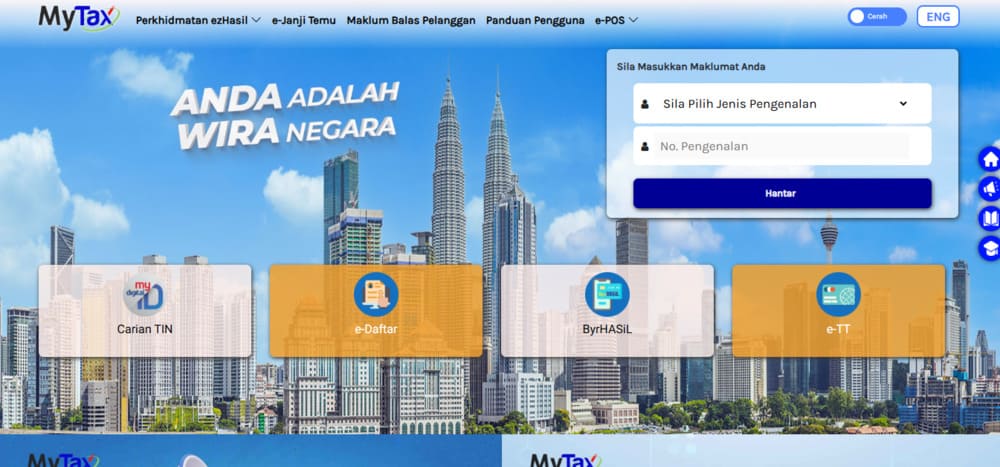
Depending on your business volume and systems, you have three practical options:
- MyInvois Portal (manual): Suitable for lower-volume businesses. You log in and enter invoice details directly. No software integration required, but this becomes time-consuming as transaction volumes grow.
- Accounting software integration: Many cloud accounting tools in Malaysia already offer direct MyInvois connectivity. If you are on Xero, QuickBooks, or a local equivalent, check whether your provider supports e-invoice submission.
- ERP or POS via API: For businesses with higher volume or existing enterprise systems, direct API integration with MyInvois provides automated real-time submission. This is the recommended path for companies processing large numbers of invoices monthly.
Want to ensure full compliance? Explore the e-invoice specific guideline to understand the detailed requirements and stay ahead of the curve.
How NKH Supports E-Invoicing and Corporate Compliance

NKH Chartered Accountants helps businesses move into e-invoicing while reducing gaps in tax records, bookkeeping, and internal processes.
As an accounting firm in Malaysia, NKH reviews your current invoicing setup, checks how MyInvois fits into your accounting system, and builds a cleaner process for invoice submission, self-billing, and record keeping.
NKH’s tax planning services in Malaysia help identify SST treatment, available exemptions, tax credits, and reporting requirements before they become audit concerns.
Through professional bookkeeping services, NKH keeps financial records aligned with e-invoice submissions, payment records, and supporting documents, giving your business a clearer audit trail and smoother compliance.
E-Invoice Compliance Checklist for Malaysian Businesses
Before your implementation deadline arrives, work through the following:
- Confirm your exact implementation date based on current annual turnover
- Review your shareholding and group structure to check whether an earlier deadline applies
- Identify all transactions that require self-billing e-invoices
- Choose your submission method: MyInvois portal, accounting software, or API integration
- Check whether your industry falls under the no-consolidation rule from January 2026
- Review capital expenditure plans to maximise the Accelerated Capital Allowance
- Speak to an advisor early to identify any compliance gaps before your deadline
Waiting until the final weeks before your deadline risks rejected invoices, disallowed expenses, and compliance penalties that are difficult to unwind.
Prepare Your Business for E-Invoicing with NKH
Meeting the e-invoice Malaysia implementation date is about more than ticking a compliance box. It is about setting up your business with the right structures, systems, and processes to stay compliant as the tax environment continues to evolve.
NKH works with Malaysian businesses to ensure corporate governance and compliance are aligned with current and upcoming regulatory requirements, including e-invoicing.
Contact NKH Chartered Accountants today for expert assistance with e-invoicing compliance and to ensure your business is fully prepared.
Frequently Asked Questions (FAQs)
Malaysia’s e-invoice implementation date depends on annual revenue, starting with businesses above RM100 million on 1 August 2024 and extending to smaller businesses by 1 July 2026.
Small businesses may need to comply if they meet the revenue threshold, have corporate shareholders, operate under a group structure, or handle related-party transactions.
E-invoicing works by submitting invoice data to LHDN through MyInvois, where the invoice is validated and recorded as an official tax document.
A self-billed e-invoice is issued by the buyer for certain transactions, including payments to overseas suppliers, agents, individuals, and dividend recipients.
Missing your e-invoice implementation date may lead to LHDN penalties, rejected invoices, tax deduction issues, and audit risks.

Kim Heng is an accounting and taxation professional whose sterling reputation has drawn countless clients to the NKH Group. When the GST was first introduced, he was commissioned to give 100+ talks on GST implementation as well as over 20++ talks on E- Invoice implementation by multiple businesses and industry associations, showing the depth of their confidence in his expertise. In the following years, Kim Heng would go on to share his knowledge on (among others) branding, tax planning, and fundraising at 20+ seminars organised by business associates that were widely attended by the public. He has over 20 years of experience consulting and advisory on taxation, corporate structure planning, business valuer, company secretarial administration, constitution advisory, and etc.