
A vesting period in ESOP determines when employees earn the right to exercise their granted share options, making it a critical part of any Employee Share Option Scheme (ESOS).
An unclear vesting structure can lead to employee retention challenges, ownership disputes, and reduced effectiveness of the incentive plan.
A properly designed vesting schedule for employee shares helps business owners reward long term commitment while keeping key employees aligned with company growth.
Founders and management teams reviewing or implementing an ESOS need a clear understanding of how the vesting period works under Malaysian law, including the timeline, conditions, and responsibilities before issuing the next share option grant.
What Is a Vesting Period in ESOP?

A vesting period in ESOP refers to the timeline employees must complete before they can exercise their granted share options.
The period defines how share options are earned over time based on the conditions established under the Employee Share Option Scheme (ESOS).
Most companies structure vesting with a cliff period, where employees must remain with the company for a specific duration, such as 12 months, before any options become available.
After the cliff is completed, the remaining options may vest monthly, quarterly, or annually until the full grant is earned.
NKH helps businesses establish clear ESOS terms, including vesting schedules, cliff conditions, and exercise requirements, ensuring the scheme is structured properly and supports the company’s long-term goals.
Contact NKH to review your company’s ESOP vesting terms before you issue your next grant.
Why a Vesting Schedule for Employee Shares Retains Malaysian Talent
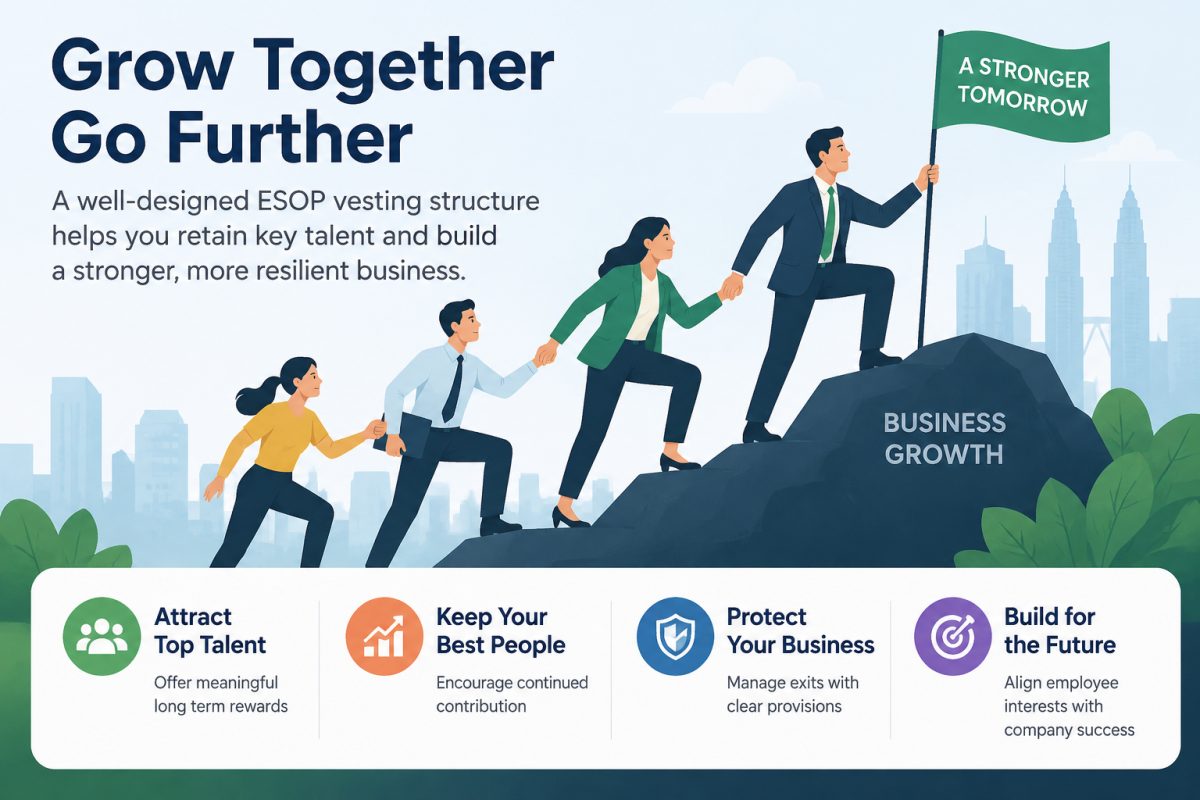
Employee share options work best when they create a connection between an employee’s contribution and the company’s future success.
A structured vesting schedule encourages key team members to remain engaged throughout important business milestones while giving SMEs a practical way to compete for skilled talent.
Many companies adopt a four year vesting structure with a one year cliff to balance employee incentives with business needs.
The arrangement rewards employees who continue contributing after the initial period while allowing the company to review commitment before releasing the full benefit.
Clear good leaver and bad leaver provisions also help prevent uncertainty by outlining how share options are treated if an employee exits due to resignation, termination, or retirement.
3 Common Structures of Vesting Schedule Employee Shares in Malaysia
Companies choose between three common vesting structures depending on company stage and workforce composition in Malaysia.
| Vesting Type | Description | Best For |
|---|---|---|
| Cliff vesting | No shares vest until a set date, typically 12 months, then the balance vests on schedule. | Early-stage companies protecting against short-term hires. |
| Graded vesting | Shares vest in equal instalments monthly, quarterly, or annually after the cliff. | SMEs building steady long-term retention. |
| Milestone-based vesting | Shares vest when the employee or company hits defined performance targets. | Growth-stage companies tying equity to results. |
Each structure sits inside the ESOS rules the board approves and lodges with the Companies Commission of Malaysia under Section 76 of the Companies Act 2016 whenever new shares or rights are allotted.
Learn more about the equity for investors and how business valuation resolves shareholder disputes in Malaysia.
Speak with NKH to confirm your chosen structure meets this lodgement requirement before your next grant date.
Legal and Tax Considerations Before You Set a Vesting Period in ESOP
The Inland Revenue Board (LHDN) treats the ESOS benefit as taxable perquisite income only when the employee exercises the option, calculated as the difference between the share’s market value on the exercise date and the exercise price.
Malaysian SMEs also need an independent valuation to support the exercise price set at grant, since an option priced below fair market value can expose both company and employee to disputes over benefit-in-kind.
NKH, a Malaysian Institute of Accountants licensed firm based in Klang, Selangor, prepares these business valuations and works through the tax timing with company directors before the ESOS is finalised.
Find out how much is your business worth through NKH’s business valuation services.
How NKH Chartered Accountants Builds a Compliant ESOP Vesting Structure

NKH builds ESOP frameworks with clear vesting schedules, exercise conditions, and documentation requirements.
The team combines expertise in accounting firm in Klang services, company secretarial compliance, and corporate valuation in Malaysia to ensure the share option scheme is supported by accurate valuations and proper reporting.
With NKH managing the advisory process under one engagement, business owners can reduce compliance risks and implement an ESOS structure that supports long term growth, employee retention, and future corporate decisions.
Frequently Asked Questions About Vesting Period in ESOP
1. What is the vesting period in ESOP?
The vesting period in ESOP is the length of time an employee must remain with the company before granted share options become exercisable, a term NKH defines in each client’s ESOS rules.
2. What is a standard vesting schedule for employee shares in Malaysia?
Most Malaysian SMEs use a four-year vesting schedule with a twelve-month cliff, though NKH tailors the schedule to each client’s funding stage and retention goals.
3. Is ESOP vesting taxed in Malaysia?
Vesting alone is not taxed in Malaysia since the taxable perquisite arises only at exercise, a benefit NKH calculates against the independent valuation it prepares for the company.
4. What happens to unvested shares if an employee resigns?
Unvested shares are forfeited under standard leaver clauses, a provision NKH drafts into the ESOS rules before any grant is issued.
5. Can a Malaysian company customise its ESOP vesting schedule?
Malaysian companies can set cliff periods, graded instalments, or milestone triggers to fit their needs, and NKH structures each option to align with Section 76 lodgement requirements.
6. How do I set up a compliant vesting schedule for my company’s ESOP?
Book a consultation with NKH in Klang, Selangor to have its corporate advisory team draft, value, and lodge your company’s ESOP vesting schedule.
Build Your ESOP With a Vesting Plan Designed for Business Growth
A successful Employee Share Option Scheme depends on clear rules that protect both the company and its employees throughout the vesting journey.
NKH put the right framework in place with ESOS advisory, valuation support, and compliance guidance handled by one experienced team.
Contact NKH today to review your vesting period in ESOP and create a structured share option plan that supports your business goals.