Equity for investors is one of the biggest decisions a Malaysian business owner will make because the percentage offered determines ownership, control, and future returns after bringing in external funding.
Most equity deals in Malaysia involve investors taking around 10% to 30% of company shares, depending on the business valuation, funding stage, and amount of capital raised.
While investor funding can help a company expand faster, agreeing to the wrong equity percentage may reduce a founder’s decision-making power or limit the value they retain in the long run.
Unlike a loan that is repaid over time, equity gives investors a permanent stake in the company’s profits, voting rights, and future exit value.
Malaysian SME owners considering angel investment, venture capital funding, or equity crowdfunding need to understand how equity allocation works before negotiations begin to secure funding without giving up unnecessary control.
What Is Equity for Investors?

When a business owner accepts funding from an investor, the exchange usually involves giving up a percentage of company ownership.
This ownership stake, known as equity for investors, determines the investor’s share of future profits, voting rights, and potential returns if the company is sold.
Deciding how much equity to offer requires careful evaluation of company valuation, funding requirements, and long-term ownership goals.
Offering too much equity may reduce founder control, while offering too little may make the opportunity less attractive to investors.
A well-structured equity arrangement helps businesses secure capital while protecting their future growth potential.
Before issuing new shares, private companies must also follow the requirements under Malaysia’s Companies Act 2016, including obtaining shareholder approval for certain share allotments that may dilute existing ownership.
NKH’s professional guidance can help founders assess investor terms, negotiate fair valuations, and structure an equity deal that supports sustainable business growth.
Speak to NKH before signing any term sheet so the equity split reflects your business’s true value, not just the investor’s opening offer.
5 Key Factors That Affect Investor Share Percentage
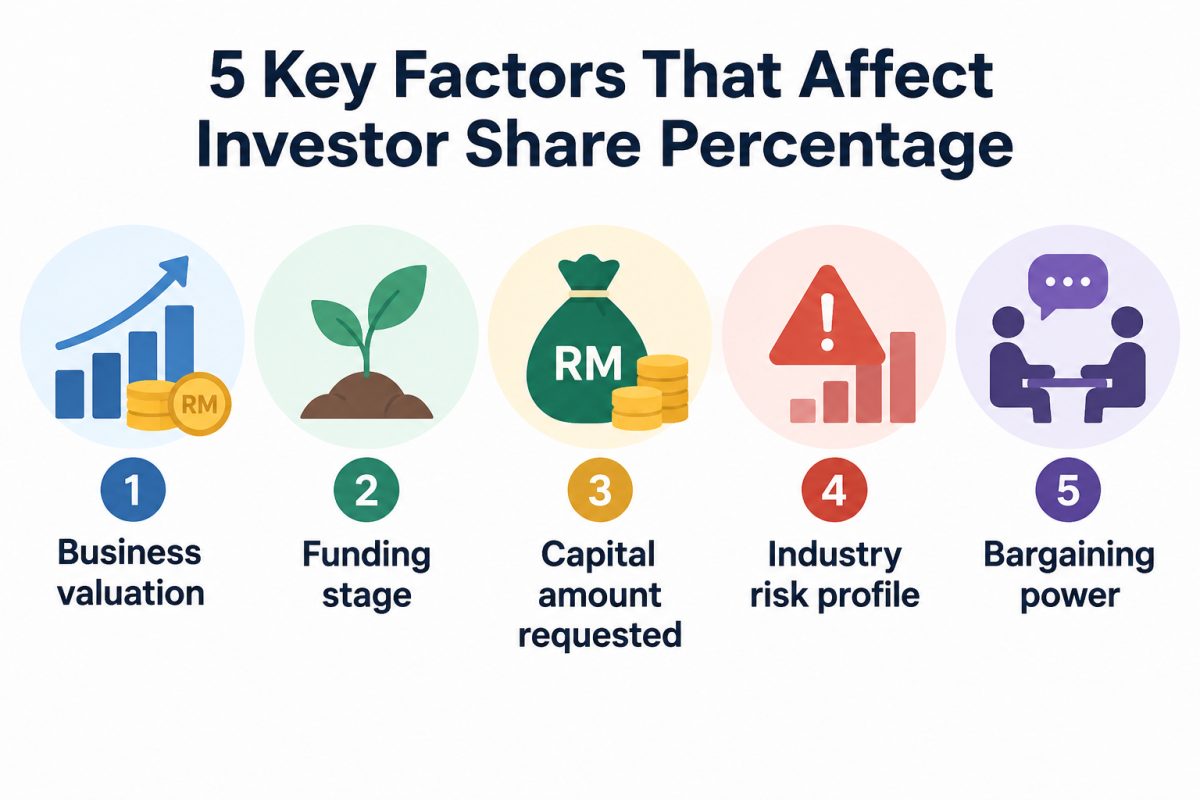
Many founders focus on how much funding they can raise but overlook how much ownership they are giving up in return.
Understanding the factors behind investor share percentage helps business owners negotiate a fairer equity deal.
- Business valuation: A higher pre-money valuation means the same capital injection buys the investor a smaller percentage.
- Funding stage: Seed-stage companies with unproven revenue give up more equity than growth-stage companies with steady cash flow.
- Capital amount requested: Raising RM500,000 against a RM2 million valuation gives away roughly 20%, while raising RM1 million against the same valuation gives away close to 33%.
- Industry risk profile: Investors demand a larger stake in capital-intensive or high-failure-rate sectors to offset the risk of losing their investment.
- Bargaining power: A founder with existing revenue, signed contracts, or competing offers keeps more equity than one negotiating from a single term sheet.
Find out what your business is worth through NKH’s business valuation approach.
What Percentage Do Investors Get by Funding Stage for Equity?
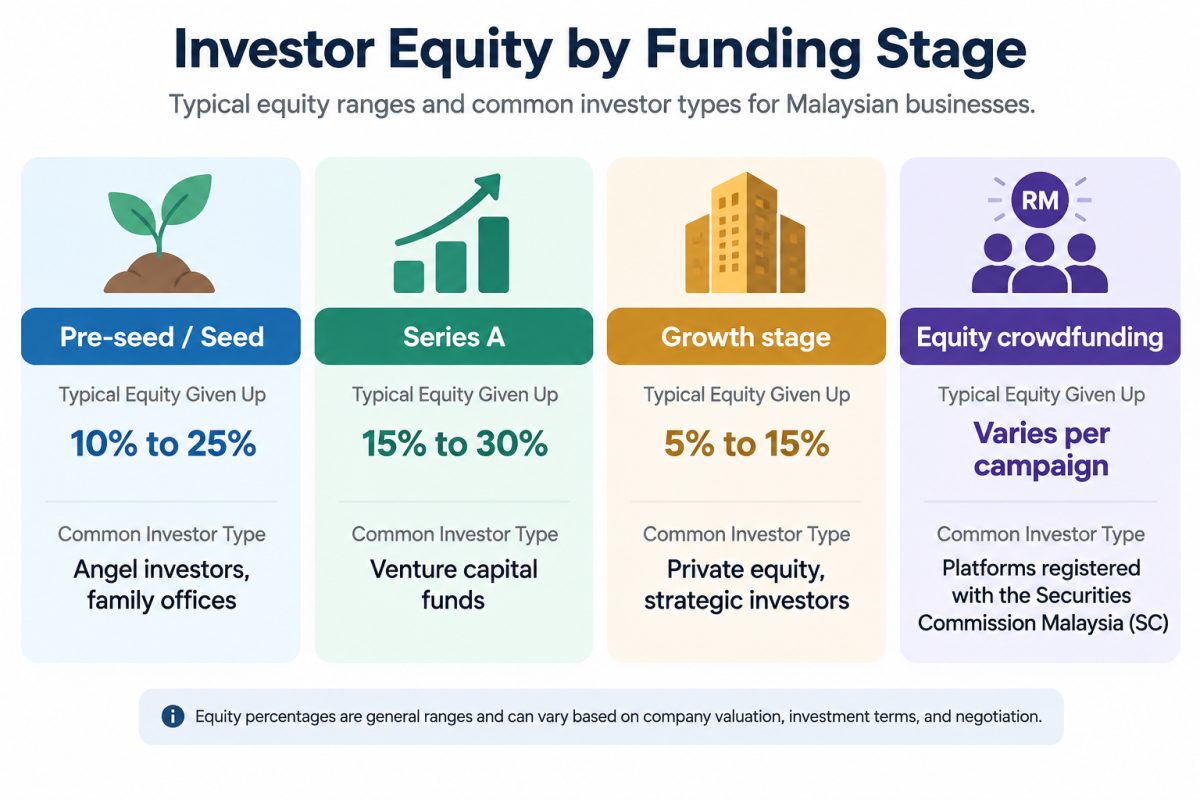
The stage of a company influences the level of risk investors take and the return they expect in exchange for their investment. Early-stage businesses often allocate a higher share percentage because they are still building market traction, revenue stability, and growth potential.
For established companies with proven performance, investor negotiations may focus on expansion opportunities, strategic value, and future returns rather than higher risk compensation. This can result in a different equity structure compared with businesses seeking their first round of capital.
Before accepting any investment offer, founders should compare the terms carefully and understand how each option affects their long-term business direction. The right arrangement allows a company to access external capital while creating a fair outcome for both founders and investors.
Find out how the vesting period in ESOP works to retain talent with share vesting.
Contact NKH to model these scenarios against your own company’s numbers before you agree to a figure with your investor.
How Business Valuation Shapes Your Equity Split

Your company’s valuation determines how much of your business an investor receives for their investment. A higher valuation means you can raise the same amount of capital while giving away a smaller percentage of shares.
Companies with stable future earnings may use discounted cash flow valuation, while asset-heavy businesses such as manufacturers or property companies may rely on asset-based valuation.
Market multiple valuation compares your company against similar businesses and recent industry deals.
NKH assesses businesses’ financial position, selects the most suitable valuation approach, and prepares a stronger basis for equity negotiations.
Learn more about what your business is worth through business valuation that minimise shareholder dispute in Malaysia.
3 Common Mistakes That Cost Founders Too Much Equity
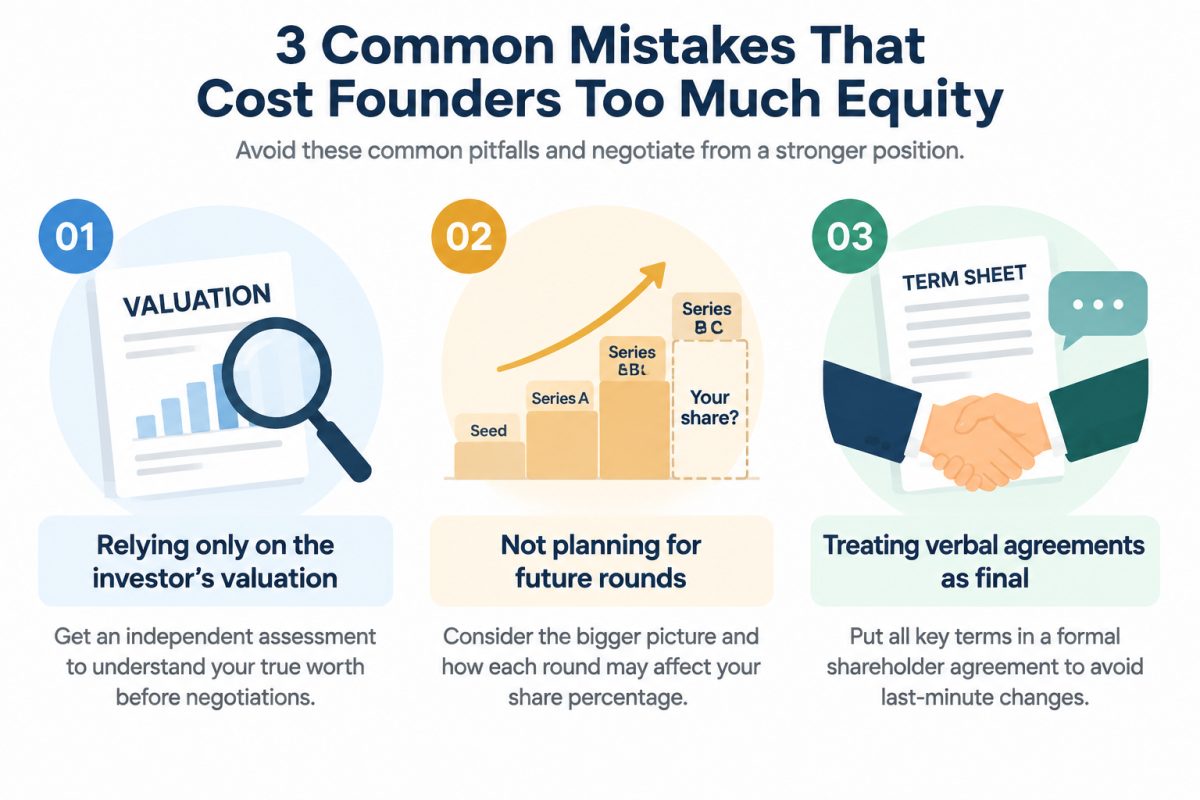
Malaysian founders repeatedly give away more equity than necessary for three avoidable reasons.
- No independent valuation on record: Founders who accept an investor’s proposed valuation without an independent review consistently give up a larger percentage than the business is actually worth.
- No dilution modelling across rounds: A founder who does not model future funding rounds can find their ownership diluted well below a controlling stake by the third round.
- Verbal agreements treated as binding: Equity percentages agreed informally before the shareholder agreement is drafted often shift once the corporate advisory team reviews the final terms.
Secure the Right Equity Deal With NKH’s Business Valuation

NKH accounting firm in Klang helps Malaysian SMEs prepare for investor discussions with professional valuation support, accurate documentation, and structured advisory.
We provide corporate valuation in Malaysia services to help founders establish a fair company value before negotiating with investors.
This gives business owners a stronger foundation to evaluate offers, protect their interests, and make informed decisions about their equity allocation.
We also assist with shareholder agreements, resolution documents, and company secretarial filings required under the Companies Act 2016, ensuring each stage of the investment process is properly documented.
With our professional guidance, founders can approach equity deals with greater confidence while building a structure that supports future growth.
Get Professional Support Before Finalising Your Investor Equity Deal
An equity agreement can shape your company’s future long after the investment is completed.
NKH helps Malaysian SMEs prepare for investor discussions with reliable business valuation and corporate advisory support, giving founders clearer insights before committing to any share allocation.
Contact NKH today to assess your business value and build a stronger foundation for your next equity investment discussion.
Frequently Asked Questions About Equity for Investors
1. What percentage do investors get for their equity stake?
Most Malaysian seed-stage founders give up 10% to 25%, though NKH’s valuation reports often shift that number based on the company’s actual asset base and revenue.
2. Does a higher valuation always mean less equity given up?
Yes, a higher defensible valuation reduces the percentage given up for the same capital amount, which is why NKH recommends an independent valuation before any term sheet discussion.
3. Can equity percentage be renegotiated after the first funding round?
Equity percentages set in earlier rounds typically stay fixed, though new share issuances in later rounds dilute every existing shareholder, including the founder, unless anti-dilution clauses are drafted by NKH’s corporate advisory team.
4. Is equity crowdfunding a good option for small Malaysian businesses?
Equity crowdfunding suits Malaysian SMEs seeking smaller capital amounts across many investors, and NKH can prepare the valuation and financial statements SC-registered platforms require.
5. Do investors get a say in company decisions with a minority stake?
Minority investors typically receive limited voting rights unless the shareholder agreement grants veto powers, a clause NKH reviews during every corporate advisory engagement.